Organisation name: Clinical Research Excellence Foundation (formerly known as ClinverseEdge)

5 May, 2025
Author : Ria Vijay
Topic : Career in Clinical Research: Hospital vs CRO vs Pharmaceutical Industry — What Should You Choose?
Clinical research is one of the fastest-growing career domains in healthcare, offering diverse opportunities across hospitals, Contract Research Organizations (CROs), and pharmaceutical companies. However, many aspiring professionals struggle with a common question:
“Where should I start—and which path is right for me?”
Some believe that pharmaceutical companies offer higher salaries, while others emphasize starting at hospitals for stronger fundamentals. The truth lies somewhere in between. Each sector plays a critical role in clinical research, and understanding their differences, advantages, and limitations is essential for making the right career choice.
Understanding the Three Pillars of Clinical Research
Before diving into comparisons, let’s briefly understand what each sector does:
- Hospitals (Clinical Trial Sites):
This is where actual patient interaction happens. Clinical trials are conducted here under the supervision of investigators (doctors).
- Contract Research Organizations (CROs):
CROs act as service providers that manage clinical trials on behalf of pharmaceutical companies. They handle operations, monitoring, data management, and regulatory processes.
- Pharmaceutical Companies:
These are the sponsors of clinical trials. They develop drugs, design studies, and oversee the entire research process from a strategic level.
Hospital vs CRO vs Pharma: Key Differences
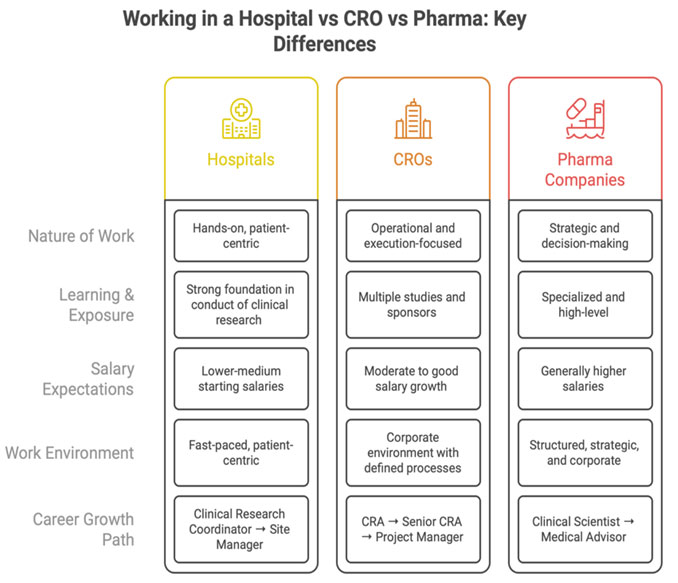
1. Nature of Work
- Hospitals:
Hands-on, patient-centric work. You directly interact with patients, assist in trial procedures, manage informed consent, and coordinate with doctors.
- CROs:
Operational and execution-focused. Roles include Clinical Research Associate (CRA), Clinical Trial Assistant (CTA), and data management.
- Pharma Companies:
Strategic and decision-making roles. Focus on study design, regulatory strategy, medical affairs, and overall project leadership.
2. Learning & Exposure
- Hospitals:
The best place to build a strong foundation. You understand protocols, patient behavior, ethics, adverse events, and real-world challenges.
- CROs:
Exposure to multiple studies and sponsors. You gain experience in trial monitoring, compliance, and global operations.
- Pharma Companies:
Exposure is more specialized and high-level. You may not see ground-level challenges but will work on big-picture strategies.
3. Salary Expectations
- Hospitals:
Usually lower starting salaries. Growth is slower initially but rich in learning.
- CROs:
Moderate to good salary growth. Increases significantly with experience, especially in monitoring roles.
- Pharma Companies:
Generally higher salaries, especially at mid-to-senior levels. Competitive packages with added benefits.
4. Work Environment
- Hospitals:
Fast-paced, unpredictable, and patient-driven. Requires adaptability and strong communication skills.
- CROs:
Corporate environment with defined processes and timelines. Travel may be required (especially for CRAs).
- Pharma Companies:
Structured, strategic, and corporate. More stability but often higher expectations.
5. Career Growth Path
- Hospitals:
Clinical Research Coordinator → Site Manager → Transition to CRO/Pharma
- CROs:
CRA → Senior CRA → Project Manager → Program Lead
- Pharma Companies:
Clinical Scientist → Medical Advisor → Leadership roles
Similarities Across All Three
Despite differences, all three sectors share common ground:
- Follow strict regulatory guidelines (GCP, ICH)
- Focus on patient safety and data integrity
- Require strong documentation and communication skills
- Offer global career opportunities
- Demand continuous learning and upskilling
Advantages & Disadvantages
Hospitals
Advantages:
- Strong foundational learning
- Direct patient interaction
- Exposure to real clinical scenarios
Disadvantages:
- Lower salary initially
- Limited corporate exposure
- Slower career progression if you stay long-term
CROs
Advantages:
- Diverse project exposure
- Faster career growth
- Opportunity to work on global trials
Disadvantages:
- High workload and deadlines
- Travel requirements (for CRAs)
- Less patient interaction
Pharmaceutical Companies
Advantages:
- High salary and benefits
- Strategic roles
- Long-term career stability
Disadvantages:
- Harder entry for freshers
- Less hands-on experience
- Specialized roles (limited exposure to entire process)
The Big Myth: “High Salary = Pharma”
Many people enter clinical research thinking that pharmaceutical companies are the ultimate goal because of higher salaries.
But here’s the reality:
👉 Without strong fundamentals, surviving in pharma is difficult.
👉 Companies prefer candidates with practical experience.
👉 Growth is faster when your basics are clear.
The Smart Career Strategy
If you truly want long-term success in clinical research, consider this approach:
Step 1: Start at a Hospital
- Build your foundation
- Understand patient handling, protocols, and ethics
- Gain real-world experience
Step 2: Move to a CRO
- Learn operations, monitoring, and global trial management
- Increase your salary and exposure
Step 3: Transition to Pharma
- Enter strategic roles with strong experience
- Achieve higher salary and leadership positions
How to Choose What’s Right for You
Ask yourself these questions:
- Do I want hands-on patient experience? → Choose Hospitals
- Do I prefer operations, travel, and dynamic roles? → Choose CROs
- Do I aim for strategy, stability, and high pay? → Choose Pharma
There is no “one-size-fits-all” answer. Your choice should align with your personality, career goals, and willingness to learn.
Final Thoughts
Clinical research is not just a job—it’s a journey.
Starting at the hospital level may seem slow, but it builds a foundation that sets you apart in the long run. CROs shape your operational expertise, and pharmaceutical companies refine your strategic thinking.
The key is not where you start, but how well you learn and grow at each stage.If you focus only on salary, you may miss the depth of learning. But if you focus on building strong fundamentals, the salary—and success—will naturally follow.
Your career in clinical research is a ladder—not a shortcut. Build it step by step, and you’ll reach the top stronger than most.
Learn more at: www.clinicalresearchexcellencefoundation.com
 +91-8422800400
 +91-8422800400
 clinicalresearchexcellencefdn@gmail.com