Organisation name: Clinical Research Excellence Foundation (formerly known as ClinverseEdge)

5 May, 2025
Author : Ria Vijay
Topic : How Freshers Can Enter Clinical Research Without Experience
Every year, thousands of students from BSc, MSc, BPharm, MPharm, MBBS, BDS, MDS, Nursing, Life Sciences, Biotechnology, Microbiology, and Allied Healthcare backgrounds complete their education and ask the same question:
“How do I enter clinical research without experience?”
Most people assume that clinical research is only for experienced professionals or doctors. Some believe that without hospital exposure or pharma experience, it is impossible to get started.
The truth is:Clinical Research Is One of the Few Healthcare Careers Where Freshers Can Enter Successfully
Yes—you can build a strong and rewarding career in clinical research even if you are a fresher.
What matters most is not years of experience, but your understanding of the industry, your practical knowledge, your communication skills, and your willingness to learn.
If you have basic knowledge of how clinical trials work and understand the fundamentals of clinical research, you are already much closer than you think.
Let’s understand how you can practically enter this exciting industry.
Before applying for jobs, you must clearly understand what clinical research means.
Clinical research is the process of testing new medicines, medical devices, vaccines, and treatment methods to ensure they are safe and effective for human use.
Every medicine available in the market today has passed through clinical trials.
Behind every successful treatment, there are professionals working in:
- Clinical Trial Management
- Regulatory Affairs
- Pharmacovigilance
- Medical Writing
- Clinical Data Management
- Quality Assurance
- Biostatistics
- Clinical Operations
- Site Management
- Monitoring and Auditing
This means clinical research is not one single job—it is an entire industry full of opportunities.
Can Freshers Really Get Jobs?
Yes—Absolutely.Many companies actively hire freshers for entry-level roles such as:
- Clinical Research Coordinator (CRC)
- Clinical Trial Assistant (CTA)
- Pharmacovigilance Associate
- Drug Safety Associate
- Medical Writer
- Clinical Data Associate
- Regulatory Affairs Executive
- Site Management Associate
- Safety Reporting Associate
- Clinical Documentation Executive
These roles are designed for beginners who are willing to learn and grow.
The biggest mistake freshers make is waiting for “perfect experience.”
Instead, companies look for:
- Basic understanding of GCP and clinical trials
- Good communication skills
- Documentation ability
- Attention to detail
- Professional attitude
- Interview confidence
Experience can be built later. Entry starts with preparation.
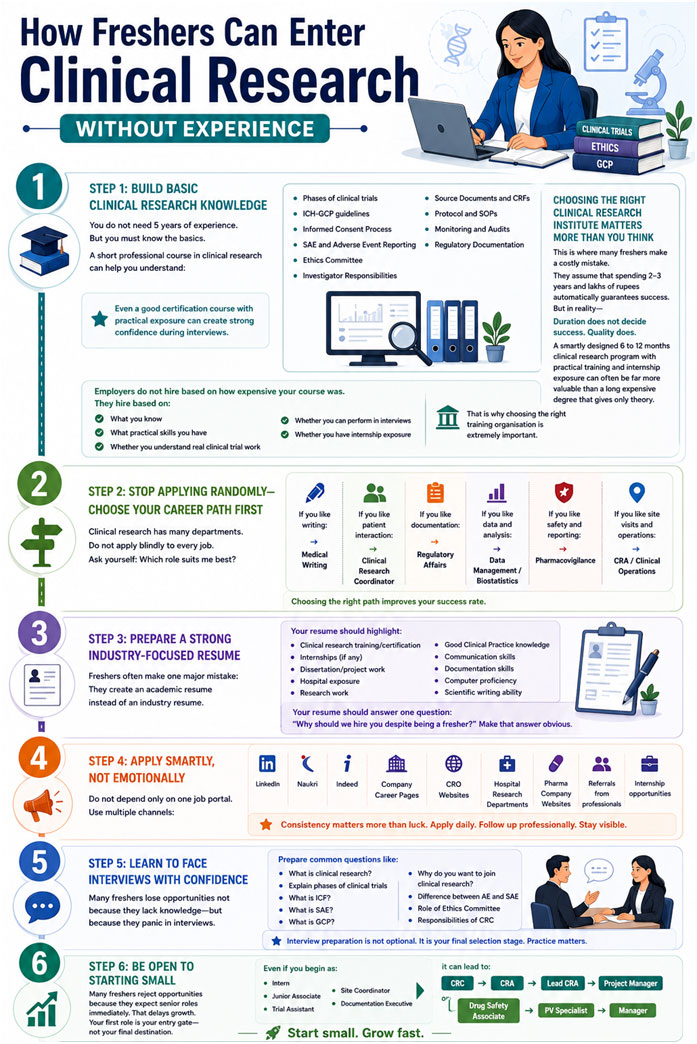
Step 1: Build Basic Clinical Research Knowledge
You do not need 5 years of experience.But you must know the basics.
A short professional course in clinical research can help you understand:
- Phases of clinical trials
- ICH-GCP guidelines
- Informed Consent Process
- SAE and Adverse Event Reporting
- Ethics Committee
- Investigator Responsibilities
- Source Documents and CRFs
- Protocol and SOPs
- Monitoring and Audits
- Regulatory Documentation
Even a good certification course with practical exposure can create strong confidence during interviews.
Choosing the Right Clinical Research Institute Matters More Than You Think
This is where many freshers make a costly mistake.
They assume that spending 2–3 years and lakhs of rupees automatically guarantees success.
But in reality—
Duration does not decide success. Quality does.
A smartly designed 6 to 12 months clinical research program with practical training and internship exposure can often be far more valuable than a long expensive degree that gives only theory.
Employers do not hire based on how expensive your course was.
They hire based on:
- What you know
- What practical skills you have
- Whether you understand real clinical trial work
- Whether you can perform in interviews
- Whether you have internship exposure
That is why choosing the right training organisation is extremely important.
How to Know If a Clinical Research Institute Is Actually Good
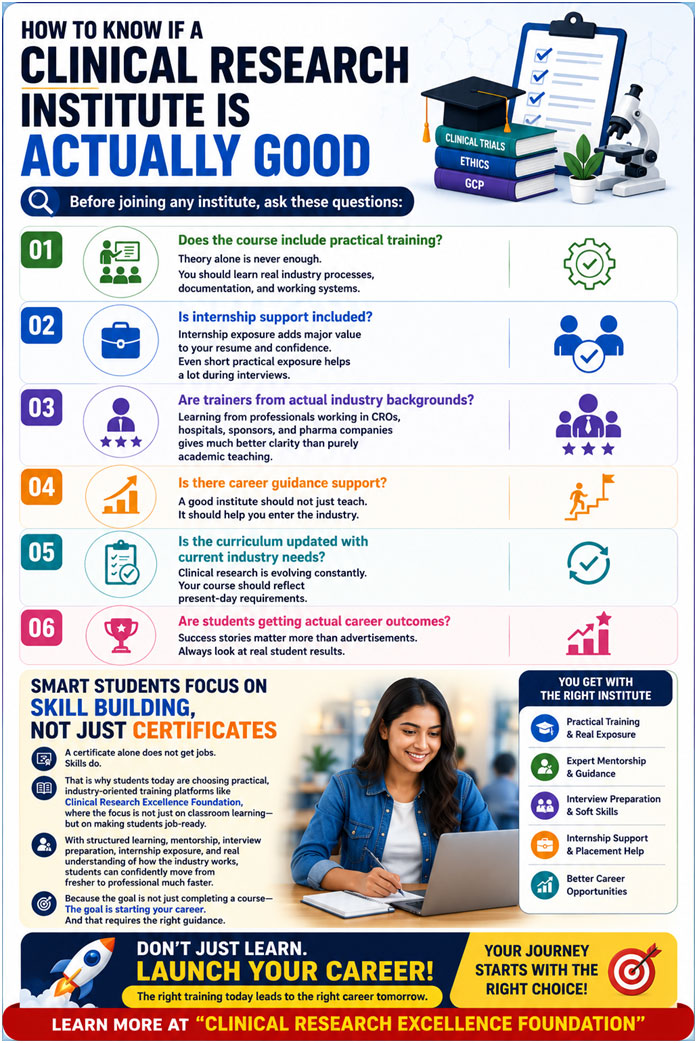
Before joining any institute, ask these questions:
Does the course include practical training?
Theory alone is never enough.
You should learn real industry processes, documentation, and working systems.
Is internship support included?
Internship exposure adds major value to your resume and confidence.
Even short practical exposure helps a lot during interviews.
Are trainers from actual industry backgrounds?
Learning from professionals working in CROs, hospitals, sponsors, and pharma companies gives much better clarity than purely academic teaching.
Is there career guidance support?
A good institute should not just teach.
It should help you enter the industry.
Is the curriculum updated with current industry needs?
Clinical research is evolving constantly.
Your course should reflect present-day requirements.
Are students getting actual career outcomes?
Success stories matter more than advertisements.
Always look at real student results.
Smart Students Focus on Skill Building, Not Just Certificates
A certificate alone does not get jobs.
Skills do.
That is why students today are choosing practical, industry-oriented training platforms like Clinical Research Excellence Foundation, where the focus is not just on classroom learning—but on making students job-ready.
With structured learning, mentorship, interview preparation, internship exposure, and real understanding of how the industry works, students can confidently move from fresher to professional much faster.
Because the goal is not just completing a course—
The goal is starting your career.And that requires the right guidance.
Step 2: Stop Applying Randomly—Choose Your Career Path First
Clinical research has many departments.Do not apply blindly to every job.
Ask yourself:Which role suits me best?
For example:
If you like writing:
→ Medical Writing
If you like patient interaction:
→ Clinical Research Coordinator
If you like documentation:
→ Regulatory Affairs
If you like data and analysis:
→ Data Management / Biostatistics
If you like safety and reporting:
→ Pharmacovigilance
If you like site visits and operations:
→ CRA / Clinical Operations
Choosing the right path improves your success rate.
Step 3: Prepare a Strong Industry-Focused Resume
Freshers often make one major mistake:
They create an academic resume instead of an industry resume.
Your resume should highlight:
- Clinical research training/certification
- Internships (if any)
- Dissertation/project work
- Hospital exposure
- Research work
- Good Clinical Practice knowledge
- Communication skills
- Documentation skills
- Computer proficiency
- Scientific writing ability
Your resume should answer one question:
“Why should we hire you despite being a fresher?”Make that answer obvious.
Step 4: Apply Smartly, Not Emotionally
Do not depend only on one job portal.
Use multiple channels:
- LinkedIn
- Naukri
- Indeed
- Company Career Pages
- CRO Websites
- Hospital Research Departments
- Pharma Company Websites
- Referrals from professionals
- Internship opportunities
Consistency matters more than luck.
Apply daily.Follow up professionally.Stay visible.
Step 5: Learn to Face Interviews with Confidence
Many freshers lose opportunities not because they lack knowledge—but because they panic in interviews.
Prepare common questions like:
- What is clinical research?
- Explain phases of clinical trials
- What is ICF?
- What is SAE?
- What is GCP?
- Why do you want to join clinical research?
- Difference between AE and SAE
- Role of Ethics Committee
- Responsibilities of CRC
Interview preparation is not optional.It is your final selection stage.Practice matters.
Step 6: Be Open to Starting Small
Many freshers reject opportunities because they expect senior roles immediately.That delays growth.
Your first role is your entry gate—not your final destination.
Even if you begin as:
- Intern
- Junior Associate
- Trial Assistant
- Site Coordinator
- Documentation Executive
it can lead to:
CRC → CRA → Lead CRA → Project Manager
or
Drug Safety Associate → PV Specialist → Manager
Start small.Grow fast.
The Biggest Truth Freshers Must Understand
Clinical Research Is a Skill-Based Industry, Not Just a Degree-Based Industry
Your degree opens the door.
Your skills decide how far you go.
Someone with practical understanding and confidence often gets selected faster than someone with only a bigger degree.
That is why training, mentorship, and industry exposure matter so much.
Final Advice for Freshers
Do not wait for confidence before starting.Start first.Confidence follows action.
Clinical research is one of the most stable, growing, and globally respected careers in healthcare today.
It offers:
- Strong career growth
- International opportunities
- Good salary progression
- Meaningful work
- Exposure to innovation
- Long-term professional stability
Most importantly—
you become part of the journey that brings life-saving treatments to patients.
That is not just a job.That is impact.
 +91-8422800400
 +91-8422800400
 clinicalresearchexcellencefdn@gmail.com