Organisation name: Clinical Research Excellence Foundation (formerly known as ClinverseEdge)

6 May, 2025
Author : Ria Vijay
Topic : Topic: High-Growth Jobs in Clinical Research You Can Start Right After Graduation
Your first job after graduation shouldn’t just be about “getting placed”…
it should be about building a career that grows with you.
That’s where clinical research stands out
The Shift No One Told You About
Every year, thousands of graduates complete degrees in life sciences, pharmacy, biotech, or medicine.
And then comes the confusion:
👉“What next?”
👉“Where are the jobs?”
👉“Why is everyone underpaid?”
Here’s the truth most people miss:
It’s not that opportunities are less.
It’s that the right opportunities are hidden in the right industries.
And clinical research is one of them.
Why Clinical Research is Booming (Especially in India)
Clinical research is no longer a niche field—it’s becoming a core pillar of global healthcare.
And India?
India is quickly turning into a global hotspot for clinical trials.
Why India is Growing Fast:
- Large and diverse patient population
- Increasing global trials shifting to India
- Cost-effective research infrastructure
- Rising number of CROs and pharma companies
👉 Global companies are investing heavily here
👉 Startups and research organizations are expanding
👉 Demand for skilled professionals is increasing rapidly
Which means one thing:
More jobs. Faster growth. Better salaries.
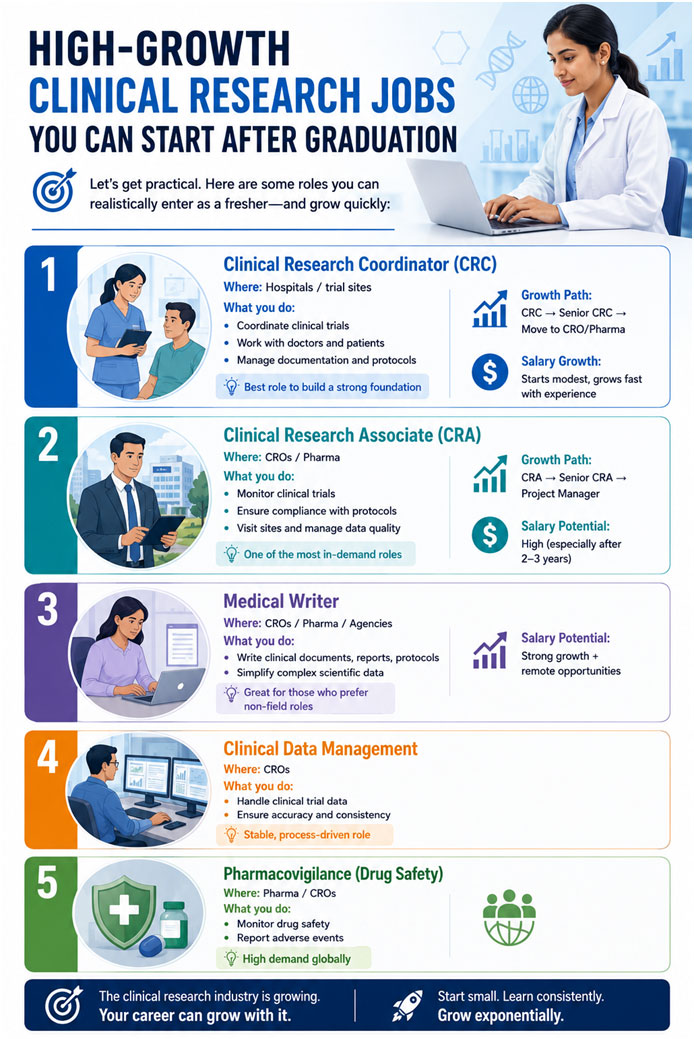
High-Growth Clinical Research Jobs You Can Start After Graduation
1. Clinical Research Coordinator (CRC)
Where: Hospitals / trial sites
What you do:
- Coordinate clinical trials
- Work with doctors and patients
- Manage documentation and protocols
💡Best role to build a strong foundation
Growth Path: CRC → Senior CRC → Move to CRO/Pharma
Salary Growth: Starts modest, grows fast with experience
2. Clinical Research Associate (CRA)
Where: CROs / Pharma
What you do:
- Monitor clinical trials
- Ensure compliance with protocols
- Visit sites and manage data quality
💡One of the most in-demand roles
Growth Path: CRA → Senior CRA → Project Manager
Salary Potential: High (especially after 2–3 years)
3. Medical Writer
Where: CROs / Pharma / Agencies
What you do:
- Write clinical documents, reports, protocols
- Simplify complex scientific data
💡Great for those who prefer non-field roles
Salary Potential: Strong growth + remote opportunities
4. Clinical Data Management
Where: CROs
What you do:
- Handle clinical trial data
- Ensure accuracy and consistency
💡Stable, process-driven role
Pharmacovigilance (Drug Safety)
Where: Pharma / CROs
What you do:
- Monitor drug safety
- Report adverse events
💡High demand globally
But Here’s the Catch (Most People Miss This)
You cannot just rely on your degree.
Because:
❌ Colleges don’t teach real clinical research skills
❌ Most graduates lack practical exposure
❌ Companies want job-ready candidates
So what happens?
👉 People apply everywhere
👉 Get rejected
👉 Assume there are no opportunities
The Real Game-Changer: Practical, Case-Based Learning
This is where smart candidates stand out.
Instead of only theoretical knowledge, they focus on:
✔ Real-world case scenarios
✔ Hands-on understanding of trials
✔ Practical documentation
✔ Industry-relevant skills
Why Case-Based Courses Work:
- They simulate real job situations
- You understand how work actually happens
- You become confident during interviews
- You stand out among other freshers
👉 Companies don’t just hire degrees
👉 They hire skills + readiness
How to Actually Get a Job Faster (Practical Roadmap)
Let’s break it down:
Step 1: Understand the Industry
Learn:
- How clinical trials work
- Drug development basics
- Key roles and responsibilities
Step 2: Choose Your Path Early
Decide:
- Patient-facing (CRC)
- Field role (CRA)
- Desk-based (Medical Writing/Data/PV)
Step 3: Build Practical Skills
- Do case-based training
- Practice documentation
- Work on real-life scenarios
Step 4: Create a Strong Profile
- Highlight skills, not just degree
- Add practical exposure/projects
- Prepare a focused resume
Step 5: Prepare for Interviews
- Understand your role deeply
- Practice explaining concepts
- Show confidence and clarity
The Advantage You Have Right Now
Most people are still:
- Confused
- Waiting
- Following outdated paths
If you act early…
👉 You can enter the industry faster
👉 Grow faster than your peers
👉 Reach high-paying roles sooner
Final Thoughts: This Industry Rewards the Smart, Not Just the Qualified
Clinical research is not just another career option.
It’s a high-growth, high-opportunity field where:
- Your skills matter more than your marks
- Your understanding matters more than your degree
- Your action matters more than your plans
You don’t need 5 years to build a successful career.
You need the right direction—and the courage to start early.
So the question is not:
“Are there jobs in clinical research?”
The real question is:
“Are you preparing yourself to grab them?”
💬If you’re a graduate looking to enter clinical research and don’t know where to start, reach out. The right guidance can change everything.
LEARN MORE AT: www.clinicalresearchexcellencefoundation.com
 +91-8422800400
 +91-8422800400
 clinicalresearchexcellencefdn@gmail.com